
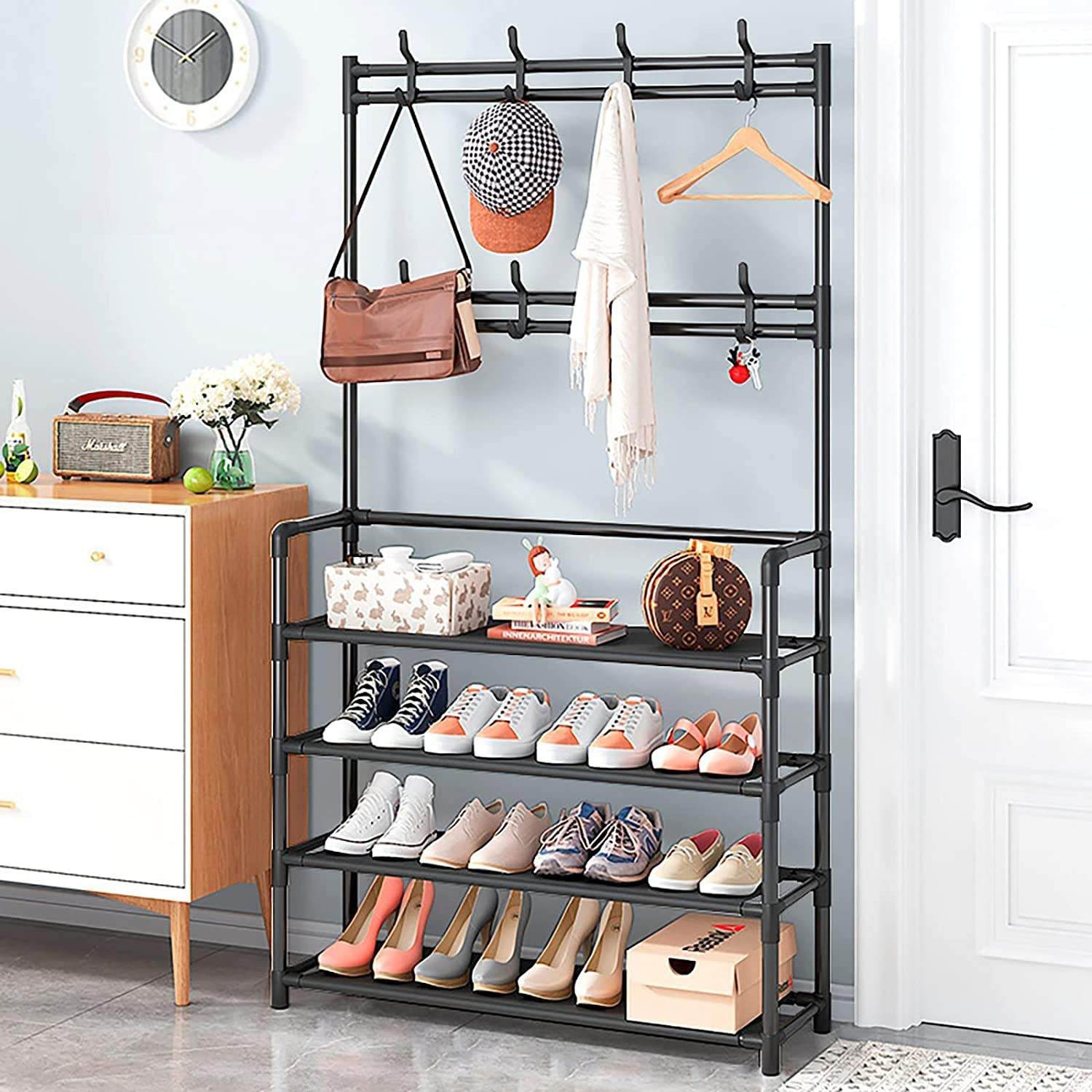
A crowded entrance with shoes and hats creates a poor first impression as the entrance is crowded with shoes and hats. The right rack not only deals with the functionality but also with the appearance of the house - it must be powerful enough to withstand the test of time, and be slim enough to fit into the houses of the modern world. In Shenzhen Deshunyi Household Products Co., Ltd., a manufacturer with over 1,800 employees, 120,000 m² in Huizhou and a new 100,000 m2 plant in Vietnam, we are manufacturing layered carbon steel racks, shoe cabinets, shoe benches and hanging organizers. There are four important points that can be identified here that would assist in locating a shoe and hat rack which would not only be strong but space effective as well.
1. Material & Construction The Pillar of Sturdiness.
Too wiggly a rack is unattractive, and irritating. Find such features which are not negotiable:
Steel gauge thickness - 1.2 mm in case of vertical posts, 1.5 mm in case of load bearing shelves. This will be thin steel (0.8-1.0 mm) which will fall down when we place heavy boots or some hat boxes on it.
Welded vs. bolted joints- Welded joints are stronger as compared to their bolted counterparts. But, when of good quality bolted racks (with triangular bracket and locking nuts) can be shipped in a flat pack, and can be assembled without the use of a tool.
Cross-bracing or back panels - Gets rid of side way sway. A shoe rack that is not cross braced and is more than 90 cm high will be inclined.
Feet design - Adjustable leveling foot (screw type) to adapt to an uneven floor. Slipping and scratches on the floors are avoided by rubber caps.
We have in operation in Deshunyi our cross-braced and 1.5 mm steel racks, which have robot-welded joints. We deflect test each design with a 150 kg load. Top shelves in the case of hat storage, in particular, should be smooth, rounded either with wire or solid panels which does not crease brims.
2. Load testing and Field Test.
The rating of manufacturers differs excessively. A rack which states that it is 50 kg might collapse at 30 kg because of poor weight distribution. Require test results, which are certified:
Uniformly distributed load (UDL) - X kg is uniformly distributed in each shelf.
Point load test A large piece of heavy equipment (e.g., work boots) at one point.
Dynamic load - Repeat putting on and taking off of shoes: Over 10,000 times.
The real requirements: in the case of shoe and hat racks, the real needs:
Casual shoes (sneakers, flats): 2–3 kg per pair → 8–12 pairs = 16–36 kg
Boots (work, winter): 5–8 kg per pair → 4 pairs = 20–32 kg
Hat boxes or stacks: 1–2 kg each → 6 hats = 6–12 kg
The weight of a stable rack should be 60-80kg. Deshunyi will provide test reports of every batch of production. One of our lines of shoe bench can hold 150 kg in a fixed posture (two adults sitting,) and 40 kg of shoe storage under the bench.
3. Space-Saving designs to fit Small door frames.
Space saving has a different meaning in various markets. Prioritize these designs:
Vertical stacking – A 3-5 tiers rack makes maximum use of the floor space and maximizes the height. Best in cases where the corridors (less than 40 cm deep) will be employed.
Slim-depth profiles - 28-32cm on average is the depth of the standard shoe. 15-20cm on average is the depth of the hat-only racks. 35cm on average is the maximum depth of the combined units.
On the floor, over-door or wall-mounted -Zero footprint. Shoe organizers (12 or 24 pockets) are hung with shoes and hats vertically at the back of a door. Hat racks mounted on the wall have pegs which do not consume a lot of space on the wall.
Tilted shelves - Slanted at 15-20 degrees, so that the toe of the shoes can be easily seen, but the depth is reduced by 20%.
Foldable or collapsible - The construction of a foldable drying rack might be used in cases where there is a spacing issue or a seasonal (e.g. small apartments) issue so that it can be foldable or even folds up.
The Deshunyi clothes rack of one pole could be loaded with shoe shelf on the bottom of the pole and hat hook in the middle of the pole that only occupies 0.3 m2 of the floor and may be loaded with 20 or even more items.
4. Accessibility, Hat-Specific features, Ventilation.
There are different needs of shoes and hats. An excellent mixed rack is able to fill both:
For shoes:
Free circulation and less odor and mould: Open shelves (not solid) allow free circulation of air.
Wet umbrella drip tray and rainy day shoe drip tray.
Raised edges to avoid sliding off of shoes.
For hats:
No shelf built of wire grid (flat top), or rounded to prevent creases on the brims.
Hooks to fit caps by the strapping or the brim that are adjustable.
Cover of dust or door of cabinet of formal hat (top hats, fedoras)
Accessibility:
At least 10 cm high above the floor to allow the bottom shelf to be easily cleaned underneath.
Middle shelves (70-110 cm) to store the daily use shoes that will be used daily.
Top shelf which can be easily reached (below 170 cm) or step stool.
The shoe cabinet line of Deshunyi has a mesh door with a ventilation and hattacks that can be detached. We have now strengthened our hanging shoe racks on the upper pockets specifically used to keep the hats and have transparent windows using PVC so that we can see inside.
Conclusion: Strong + Small= The Right Rack.
The selection of shoe and hat rack should be based on a combination of the material strength, weight capacity that has been confirmed, intelligent space-saving designs and ventilation. Give priority to steel gauge (1.2 mm+), cross-bracing, adjustable feet and open shelving. To save on space, use vertical stacking or slim depths, wall mounted or multifunctional designs.
Being a trusted Chinese-Vietnamese manufacturer of shoe racks, hat racks, and combined units, Deshunyi can provide custom sizing, finish, and load rating of its shoe racks, hat racks, and combined units, such as vinyl record storage, shoe benches, and layered carbon steel racks. Request samples and test reports before placing your next wholesale order.