
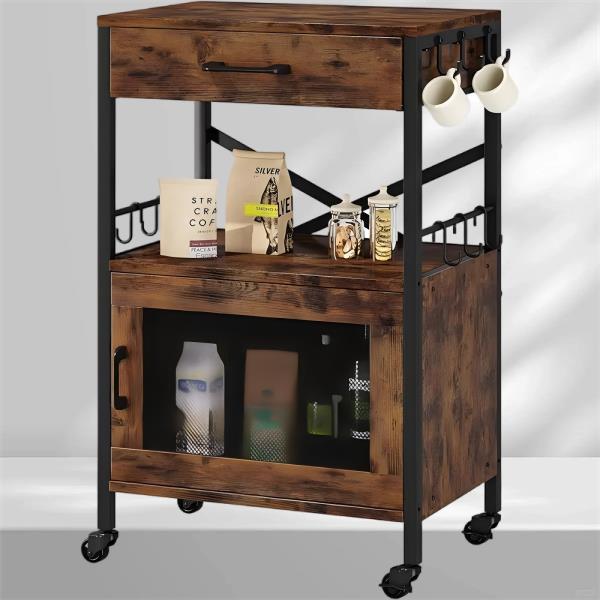
We know that a shelving rack is definitely much more than metal beams and panels at Shenzhen Deshunyi Household Products Co., Ltd. It is a well thought-out structure in which design is what really determines performance. Geometry is one of the most important but most neglected aspects of this engineering. The geometry, angles and spatial layout of the parts will be the key determinant of the stability of a rack and the safety with which it carries its weight. This blog dwells into geometrical concepts of developing trustworthy storage solutions.
The Foundation of Stability, Upright Spacing and Base Design
The gap between the straight upright frames constitutes the major geometric footprint of any shelving rack. By means of uprights which are placed at strategic intervals, a wider base is inherently formed, and this is resistant to forward forces or backward forces which cause the object to tip over. Consider it to be a variation between a small stool and a wide armchair. In Shenzhen Deshunyi, we have designed our designs with an optimal upright spacing that will maximize this stability footprint without affecting the space efficiency. Moreover, it is vital that the geometry of the base is important. Integral footplates or the possibility of bolted bases provide a bigger surface contact with the floor. This geometric expansion at the ground level converts point loads to distributed loads, which increases the ability of the rack to resist the amounts to shifting or swaying when loading or unloading.
Beam Configuration and Vertical Load Distribution
The manner in which the horizontal beams are actually attached to the uprights is a masterpiece of transfer of loads geometrically. A beam constructed well does not just rest on a peg but has a positive locking system with the upright column. The geometry of this connection commonly incorporating hooks, bolts, or special tabs, dictates the effectiveness with which the weight is passed off the shelf surface and down through the upright and into the floor. Our engineering is aimed at the development of beam-end geometries guaranteeing a smooth and inflexible transfer path. This avoids local stress points which may cause deformation. The spacing of these beams is also vertical. Tighter vertical spacing enables the weight to be spread over a greater number of points of connection and support shorter objects, avoiding excessive concentration of the load at one shelf level.
Overall Frame Geometry and Resistance to Lateral Forces
In addition to the constituent parts, the total three dimensional structure of the rack frame determines its capability to resist lateral forces, such as when an accidental impact is experienced or on an uneven surface. In engineering, the triangle form is the most stable. Although a simple shelving unit is rectangular, in our designs we take the principles of triangular bracing. This can be done by strategic utilization of diagonal cross-braces or, in the case of boltless racks, by the hard, triangulated structure of the connector joints connecting beams and uprights. The rectangular frame is made up of a series of rigid triangles instead of a parallelogram that is easy to rack out of shape and has poor squareness and integrity under load.
The design philosophy of our Shenzhen Deshunyi Household Products Co., Ltd. is based on these structural geometry principles. The proportions, angles, and connection points are carefully calculated to make sure that each rack that we make has not only a storage space, but foreseeable safety and durability over time. We provide solutions that you can rely on to work by mastering the hidden geometry of stability, one that will perform on shelf after shelf, and load after load.